Essay
12
min read
The architecture of an uninterrupted morning
Most productivity advice focuses on willpower. The real leverage is structural — rearranging the containers your day arrives in so the deep work doesn't have to fight for space.

I used to think the problem was discipline. Every Sunday night, I'd block two hours on Monday morning for deep work. By 9:47 AM, someone had dropped a "quick sync" into the gap. By Tuesday, the block was gone entirely. I'd try again the next week.
After two years of this, I stopped blaming myself and started looking at the structure. The calendar isn't neutral — it's an invitation system biased toward the interruptible. Anyone can claim your time. Nobody can protect it but you.
The container problem
Knowledge work arrives in containers: meetings, email threads, Slack channels, documents. Each container has a shape — a duration, an energy cost, a recovery time. A 30-minute meeting doesn't cost 30 minutes. It costs the 30 minutes plus the 15 before it (when you can't start anything real) plus the 12 after it (when your brain is still in the room).
A day with six 30-minute meetings doesn't leave you with five hours of free time. It leaves you with five hours of fragments — and fragments can't hold deep work.
The problem isn't that you have too many meetings. It's that the meetings are load-bearing walls in a floor plan designed for open space.
Rearranging, not removing
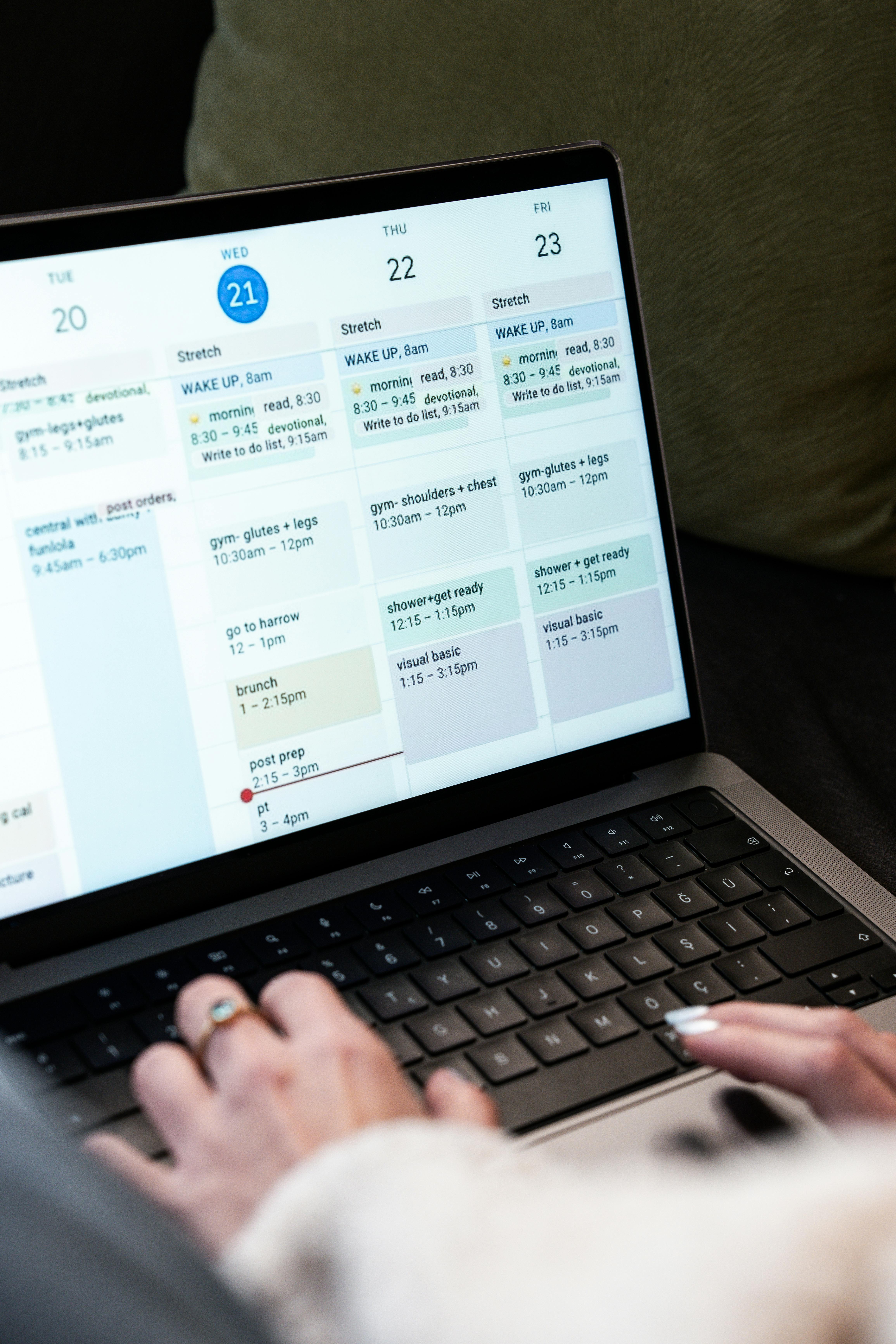
The instinct is to cancel meetings. That's a political fight, not a structural one. The better move is to rearrange them — cluster the shallow containers together so the gaps between them disappear, and the remaining open space consolidates into something usable.
This is what Quietflow does automatically. It reads your calendar, identifies the movable blocks, and proposes a rearrangement that maximizes the longest unbroken window. You don't lose any meetings. You lose the dead space between them.
Energy is the real schedule
Not all hours are equal. Most people have a cognitive peak — a two-to-three hour window where complex thinking comes easiest. For the majority, it's morning. For some, it's late afternoon or evening.
The research here is well-established. Circadian performance curves show predictable peaks and troughs in alertness, working memory, and executive function. What varies is the phase — when your peak falls — not whether you have one.
What Quietflow measures
After five workdays of calibration, the energy model combines three signals: your calendar patterns (when you schedule vs. when you actually produce), your input cadence (typing speed and consistency as a proxy for cognitive load), and optional wearable data (HRV, motion). The result is a daily curve that gets sharper over time.
Once you know where the peak is, the scheduling problem becomes simple: protect that window at all costs. Move everything else around it. The peak is the load-bearing wall — the meetings aren't.
The disappearing product
The hardest part of building Quietflow wasn't the scheduling engine. It was deciding what not to show. Every productivity tool wants to be the center of your attention. We wanted the opposite — a product that does its best work when you forget it's running.
No dashboard to check every morning
No gamification, no streaks, no badges
No push notifications about your "productivity score"
The weekly readout arrives once, in your inbox, and it's two paragraphs
This is a hard sell in a market that rewards engagement metrics. But the math works differently when your product is measured in hours returned, not hours spent inside the app.
On sound
The soundscapes were a late addition — something Tomás prototyped over a weekend that we couldn't stop using. The insight was that ambient sound doesn't need to be good. It needs to be invisible. When you notice the music, it's already failed.
The mixes adapt in real time, but slowly. A shift takes 30 seconds to land. If your typing cadence drops (a sign of drift), the low-frequency elements tighten. If you're locked in, the mix opens up and breathes more. You never hear the transition.
Designing for the morning
Here's what an uninterrupted morning looks like, structurally:
The calendar is already rearranged — your peak window is clear
DND activates automatically when the session starts
The ambient mix fades in at a level calibrated to your headphone volume
No browser tab competes for your attention — the session occupies the space
When you stop — stand up, close the laptop, walk away — the session ends itself
That's the architecture. It's not complicated. It's just extremely hard to build a business around something that disappears the moment it's working.
But after two years of running it ourselves, and twelve months of watching 12,000 people use it, I'm convinced this is right. The best productivity tool is the one that gives your time back and then gets out of the way.
Keep reading.
Stay in the quiet.
Fourteen days free. No card. Cancel by closing the tab — we won't email you about it.